A recent NPR podcast asked people to debate the question, "Is The Internet Closing Our Minds Politically?". It was fascinating, mostly because there were some very different beliefs about information behavior online. The basis was whether or not "we [are] running the risk of getting trapped in information bubbles, where all we read and see falls in line with our political views?"
And while I find both sides have some interesting points, it it worth examining some of the information behavior and access assumptions underlying the two arguments. I understand that I am part of an elite minority with my education and background, but I don't think it is elitist view to say that I don't believe everyone has equal access to information nor equal knowledge about how to seek out information. Perhaps having a degree in information management makes me biased about information behavior, but the internet for many people has certainly changed the dissemination and acquisition of information. The saying "If its on the Internet, it must be true" is usually said sarcastically, but too often it is a key part of decision making. People find information from a source, and based on prior experience, biases and beliefs (or what is said in social circles), the source is given more or less validity. People decide "oh, I know this source is trustworthy" or "oh, this source is a joke". And the more they trust the source, the easier it becomes to assume the source has verified its information (which in an ideal world would be what all news agencies do).
One key thing that I value about being a researcher in a business environment is that it is really, really important that I understand my information sources. While doing economic or industry research, most of the time there are conflicting sources for data I need, whether its employment numbers in a state or the number of operations in a certain industry. If I find a secondary source that analyses primary data, I need to know what data they were including and how they crunched those numbers. I have seen it bleed into other areas of my life, making me all the more curious about where people get their information and what assumptions are based upon.
When sites on the internet such as Facebook, Google, and Twitter engage is social filtering behavior (tailoring search results to each user), that can change what information we are exposed to when we search online. The argument was made that this can be beneficial - crowdsourcing results through your social circle might expose you to new ideas. But is that really the case? Do many people actually surround their digital selves with people who have opposing viewpoints? Isn't one of the more powerful parts of online interactions is that people with similar outlooks and beliefs can more easily congregate, regardless of where they are in the physical world? I'm not sure people need help seeking out others who view the world like they do.
People need help finding information that expands their knowledge, not constrains or limits it. And that is a lot harder to do than filter out and customize results.
Showing posts with label social media. Show all posts
Showing posts with label social media. Show all posts
Tuesday, May 1, 2012


Monday, October 24, 2011
Comments
Someone recently shared a link to a blog, pointing out the comments section introduction:
"Please use the comments to demonstrate your own ignorance, unfamiliarity with empirical data, ability to repeat discredited memes, and lack of respect for scientific knowledge. Also, be sure to create straw men and argue against things I have neither said nor even implied. Any irrelevancies you can mention will also be appreciated. Lastly, kindly forgo all civility in your discourse . . . you are, after all, anonymous."
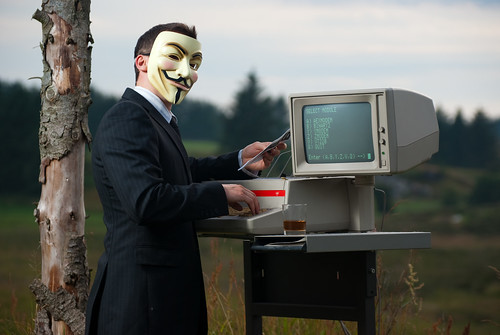
I thought this was brilliant. I am not someone who comments often on articles or blogs, but I sometimes glance through the comments when I finish reading. I primarily browse through the online versions of BBC News and the Seattle Times, for world and local news, respectively. The Seattle Times commentators certainly fit the above statement a little too closely for my liking. It frequently seems to be a free-for-all to see who can come up with the most idiotic or unsubstantiated content, belittling others and generally presenting themselves poorly. People seem to sometimes react to the feeling anonymity in the digital realm by behaving in very different manners than they would in-person.
In my information ethics course, we discussed the pros and cons of anonymity from both an ethical and policy perspective. It isn't a clear-cut, black and white issue, but it is an important area to consider as new technologies and information behavior continue to emerge and evolve. There are cases where anonymity can facilitate more honest feedback, particularly when there are power disparities that hinder people from feeling completely able to voice opinions otherwise. Employee engagement/feedback surveys are a good example of this.
But for something like social media or other by-choice dialogue, I wonder if anonymity is the best choice. I understand the comments on cute kitten pictures at icanhazcheeseburger.com don't often take a serious tone, and I wouldn't argue that a site like that requires full name disclosure. But on a newspaper site like the Seattle Times? I think that it is a little too convenient for people to say outrageous things on an issue, throw out all sorts of data that they do not back up, and do it all rudely.
In terms of social media, I was really disappointed with the newest development by Google on their most recent foray into social media, Google+. Google initially instated a policy that required users to use their real names when signing up for Google+. I seemed to have missed most of the commentary and "controversy" over that, but Mashable recently reported that Google would be relaxing that policy to support pseudonyms and nicknames. Seems like that move will dilute the community-concept (including knowing who your neighbors/'friends' are) that Google was going for. Ah well. Maybe I'll go post an anonymous comment about my concerns.
"Please use the comments to demonstrate your own ignorance, unfamiliarity with empirical data, ability to repeat discredited memes, and lack of respect for scientific knowledge. Also, be sure to create straw men and argue against things I have neither said nor even implied. Any irrelevancies you can mention will also be appreciated. Lastly, kindly forgo all civility in your discourse . . . you are, after all, anonymous."
I thought this was brilliant. I am not someone who comments often on articles or blogs, but I sometimes glance through the comments when I finish reading. I primarily browse through the online versions of BBC News and the Seattle Times, for world and local news, respectively. The Seattle Times commentators certainly fit the above statement a little too closely for my liking. It frequently seems to be a free-for-all to see who can come up with the most idiotic or unsubstantiated content, belittling others and generally presenting themselves poorly. People seem to sometimes react to the feeling anonymity in the digital realm by behaving in very different manners than they would in-person.
 |
| Photo by Stian Eikeland |
In my information ethics course, we discussed the pros and cons of anonymity from both an ethical and policy perspective. It isn't a clear-cut, black and white issue, but it is an important area to consider as new technologies and information behavior continue to emerge and evolve. There are cases where anonymity can facilitate more honest feedback, particularly when there are power disparities that hinder people from feeling completely able to voice opinions otherwise. Employee engagement/feedback surveys are a good example of this.
But for something like social media or other by-choice dialogue, I wonder if anonymity is the best choice. I understand the comments on cute kitten pictures at icanhazcheeseburger.com don't often take a serious tone, and I wouldn't argue that a site like that requires full name disclosure. But on a newspaper site like the Seattle Times? I think that it is a little too convenient for people to say outrageous things on an issue, throw out all sorts of data that they do not back up, and do it all rudely.
In terms of social media, I was really disappointed with the newest development by Google on their most recent foray into social media, Google+. Google initially instated a policy that required users to use their real names when signing up for Google+. I seemed to have missed most of the commentary and "controversy" over that, but Mashable recently reported that Google would be relaxing that policy to support pseudonyms and nicknames. Seems like that move will dilute the community-concept (including knowing who your neighbors/'friends' are) that Google was going for. Ah well. Maybe I'll go post an anonymous comment about my concerns.
Monday, January 24, 2011
Emerging Technologies - Connecting or Isolating?
There are some interesting conversations happen around the world about the role of social media and how human behavior is changing alongside the emergence of the newest ways of communication.
Recently on the Colbert Report, Sherry Turkle talked about her recent book "Alone Together". The thesis of her book is summed up by a recent by Paul Harris in an article in The Guardian: "technology is threatening to dominate our lives and make us less human. Under the illusion of allowing us to communicate better, it is actually isolating us from real human interactions in a cyber-reality that is a poor imitation of the real world."
I think this is a fascinating hypothesis, worth conversation and further exploration. I seem to, by default, love the ease of communication and accessibility I have to friends around the world. When you have friends from Canada to England, Germany to Cambodia, and France to Honduras, it seems somewhat miraculous to be able to email, call (with video), text, and instant message all of them for either free or very reasonable prices. Fifty years ago - heck, twenty five years ago - this kind of communication would have racked up a bill a mile long. But I take it for granted that I can instantly write an email to the child I sponsor in Honduras, then have a free video Skype call with my friend in Cambodia, and follow it up with sending a text for just a few cents to another friend in England.
Yet this access does make it difficult to keep up with everyone. I rarely sign into Skype these days, often because I find it more distracting that I can afford with work and school, or simply because I forget to. Emails that are easy to send sometimes take weeks for me to get around to finishing, and loiter in my drafts box for a while. There are so many ways to communicate these days, but I still have many days where I feel the lack of communication in my life. I still write hand-written letters every once in a while, simply because there is something incredibly special about sending and receiving "snail-mail".
But I'm not sure that we're being isolated because of this technology. I think it is a possible repercussion for some people, but I'm not sure it is a societal epidemic. The key point, though, that I take away from this book and the idea of "cyber-skepticism" is that it is good to be skeptical. Just because social patterns are forming does not mean those are necessarily positive steps forward. There is the cited story about the woman who left a Facebook suicide note, and her 1,048 "friends" on Facebook failed to take action to do something, or take it seriously. I think this is a tragic story where there was a disconnect between cyber-life and "real"-life, and should serve as a catalyst for self-examination as an internet society. At the end of the day, I think it isn't the technology we have to worry about - social media is only the tool, neutral without the people and actions behind it.
Recently on the Colbert Report, Sherry Turkle talked about her recent book "Alone Together". The thesis of her book is summed up by a recent by Paul Harris in an article in The Guardian: "technology is threatening to dominate our lives and make us less human. Under the illusion of allowing us to communicate better, it is actually isolating us from real human interactions in a cyber-reality that is a poor imitation of the real world."
I think this is a fascinating hypothesis, worth conversation and further exploration. I seem to, by default, love the ease of communication and accessibility I have to friends around the world. When you have friends from Canada to England, Germany to Cambodia, and France to Honduras, it seems somewhat miraculous to be able to email, call (with video), text, and instant message all of them for either free or very reasonable prices. Fifty years ago - heck, twenty five years ago - this kind of communication would have racked up a bill a mile long. But I take it for granted that I can instantly write an email to the child I sponsor in Honduras, then have a free video Skype call with my friend in Cambodia, and follow it up with sending a text for just a few cents to another friend in England.
Yet this access does make it difficult to keep up with everyone. I rarely sign into Skype these days, often because I find it more distracting that I can afford with work and school, or simply because I forget to. Emails that are easy to send sometimes take weeks for me to get around to finishing, and loiter in my drafts box for a while. There are so many ways to communicate these days, but I still have many days where I feel the lack of communication in my life. I still write hand-written letters every once in a while, simply because there is something incredibly special about sending and receiving "snail-mail".
But I'm not sure that we're being isolated because of this technology. I think it is a possible repercussion for some people, but I'm not sure it is a societal epidemic. The key point, though, that I take away from this book and the idea of "cyber-skepticism" is that it is good to be skeptical. Just because social patterns are forming does not mean those are necessarily positive steps forward. There is the cited story about the woman who left a Facebook suicide note, and her 1,048 "friends" on Facebook failed to take action to do something, or take it seriously. I think this is a tragic story where there was a disconnect between cyber-life and "real"-life, and should serve as a catalyst for self-examination as an internet society. At the end of the day, I think it isn't the technology we have to worry about - social media is only the tool, neutral without the people and actions behind it.
Sunday, January 16, 2011
Keeping Our Troops Connected
A recent headline on Wired.com made me pause: "Tweet Away, Troops: Pentagon Won’t Ban Social Media".
There has actual been the serious possibility that the Pentagon would ban soldiers from using social media sites such as Twitter and Facebook? It boggles my mind - many of the troops now are being more and more made up of digital natives. You might as well tell them they're banned from talking as tell them they can't use social media, especially to communicate with their friends and family. As Robert Mason et al. describe them, these youngest generation of adults have “grown up in a world surrounded by connectivity and digital tools. They are ‘net natives’ or ‘digital natives.’ These are people who have never known a world without the Internet, instant messaging, online games, and the possibility of persistent digital presence with networks of people.” You're not going to be able to tell we of this digital native generation that we can't have our Facebook or Twitter fix. Sorry, it just isn't going to happen. Social media is a force that is moving forward, not winding down.
** Edit Note: If you read the comments, Jordan makes some very good points that should be integrated into my little ramble here. I really agree with her when it comes down to the fact that sometimes take an entitlement approach to social media. Just because we behave a certain way doesn't mean we should. **
** Edit Note: If you read the comments, Jordan makes some very good points that should be integrated into my little ramble here. I really agree with her when it comes down to the fact that sometimes take an entitlement approach to social media. Just because we behave a certain way doesn't mean we should. **
Apparently, the bright idea of banning came from military officials who feared that social media caused too much security hassle, and took up too much bandwidth. So to say again, in 2009 the military was "seriously considering" a complete ban. The reason that this is now back in the news is because come March of this year, the 2009 policy that "enshrined military access to social media" is expiring, which only came after a long battle.
Hopefully, there wont' be any more malarky about banning or limited access. Because frankly, if the military did do something like this, the country would probably have to implement a draft. And then there would be riots in the street... and on Twitter.
Subscribe to:
Posts (Atom)