Monday, October 24, 2011

Comments

Someone recently shared a link to a blog, pointing out the comments section introduction:

"Please use the comments to demonstrate your own ignorance, unfamiliarity with empirical data, ability to repeat discredited memes, and lack of respect for scientific knowledge. Also, be sure to create straw men and argue against things I have neither said nor even implied. Any irrelevancies you can mention will also be appreciated. Lastly, kindly forgo all civility in your discourse . . . you are, after all, anonymous."

I thought this was brilliant. I am not someone who comments often on articles or blogs, but I sometimes glance through the comments when I finish reading. I primarily browse through the online versions of BBC News and the Seattle Times, for world and local news, respectively. The Seattle Times commentators certainly fit the above statement a little too closely for my liking. It frequently seems to be a free-for-all to see who can come up with the most idiotic or unsubstantiated content, belittling others and generally presenting themselves poorly. People seem to sometimes react to the feeling anonymity in the digital realm by behaving in very different manners than they would in-person.
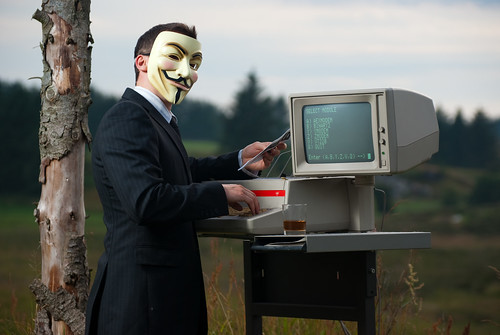
Photo by Stian Eikeland

In my information ethics course, we discussed the pros and cons of anonymity from both an ethical and policy perspective. It isn't a clear-cut, black and white issue, but it is an important area to consider as new technologies and information behavior continue to emerge and evolve. There are cases where anonymity can facilitate more honest feedback, particularly when there are power disparities that hinder people from feeling completely able to voice opinions otherwise. Employee engagement/feedback surveys are a good example of this.

But for something like social media or other by-choice dialogue, I wonder if anonymity is the best choice. I understand the comments on cute kitten pictures at icanhazcheeseburger.com don't often take a serious tone, and I wouldn't argue that a site like that requires full name disclosure. But on a newspaper site like the Seattle Times? I think that it is a little too convenient for people to say outrageous things on an issue, throw out all sorts of data that they do not back up, and do it all rudely.

In terms of social media, I was really disappointed with the newest development by Google on their most recent foray into social media, Google+. Google initially instated a policy that required users to use their real names when signing up for Google+. I seemed to have missed most of the commentary and "controversy" over that, but Mashable recently reported that Google would be relaxing that policy to support pseudonyms and nicknames. Seems like that move will dilute the community-concept (including knowing who your neighbors/'friends' are) that Google was going for. Ah well. Maybe I'll go post an anonymous comment about my concerns.

Monday, October 10, 2011

A 15 page report? That'll be $1,295 please.

One aspect of my role as a researcher for an accounting firm is to provide industry and economic outlook write-ups as part of larger client projects. As a department, we subscribe to a number of different services that allow us access to reports and analysis, but I also look for other relevant sources for each topic. I often find reports that look like they may be relevant, but require a subscription that the department does not hold.

For the most part, the subscription-based model is understandable if annoying to someone like me. I wouldn't want to access the source if it weren't valuable, and if it is a business producing the data and/or analysis, it makes sense that they charge for it.

But the amount sometimes seems somewhat disproportionate. I recently found a Gartner market report that seemed likely to contain pertinent information. I knew we don't subscribe to them, but I was hoping to find a report that might be summarized or quoted elsewhere. I glanced down at the purchasing information out of curiosity... $1,295.00 for a 15 page report.

Hmmm. So that doesn't fit the budget.

Honestly though, the value-add of the information I could fish from that doesn't seem to match the price tag. It makes me wonder who would consider the data and analysis in those 15 pages actually worth it to pay out that much money. And it also makes me really curious about what kind of content is in the report! That has to be some excellent and astounding research, right?

At least I hope it is...

PS: If only I had figured out a way to charge $86 dollars a page during my undergraduate and graduate school experience... they I might have made a profit rather than being in six-digit debt.

Thursday, September 29, 2011

Read, Analyze, and Write... QUICKLY

The most amazing thing about being a professional researcher outside an academic context? [Okay, other than the paycheck] The fact that there is a direct link between the work I'm doing and some sort of business action that takes place. I went into a MS graduate program largely because I was frustrated by the idea of continuing down the pure-academia route. It is critical to study and analyze the world, but all the research that I did as an undergrad... where was the value to anyone other than me as I developed analysis and writing skills? Of course not everything done needs to have an identifiable value attached to it, but from a career point of view? Well I have finally found a route that puts all the skills I've worked on building the last six years through "higher education", and that is working as a researcher at an accounting and consulting firm in Seattle. It is the most amazing opportunity I never would have known I was missing out on if I hadn't been hired. 


The best parts so far have been the incredible office environment (unlimited Starbucks brewed coffee... I mean, really?) and people that have welcomed me to the firm. The work is challenging and extremely different. I mean really, anyone who knows me never would have guessed I would end up working in an even remotely finance-related environment. Without going into specifics, it isn't your typical research-type job. We're meant to be a resource for the firm, yes, but we're doing it with an output/results focus that includes billable hours and profit. 


My most enjoyable projects thus far have been the industry-related writing pieces I've done, which means I've gotten to research up on the motorcycle industry, paint & sealant manufacturing, semiconductor manufacturing, and property management so far. The diversity of topics and the variety of frameworks means that I've found my ideal career context. I'm working in an environment that keeps my brain engaged, the type of work changes frequently, and I am in a constant learning mode. 


Basically I've found a way to be a paid perpetual student. Man I love it.


PS: Writing on my lunch break, I have to admit, I love the view when I turn around in my desk chair. It's a good thing I don't face the window, because I'm not sure I would be able to concentrate.

Wednesday, September 21, 2011

Real-World, Here I Come

Well I am officially not a graduate-school geek. That whole graduation thing happened a few months ago, and I’ve been acclimating to non-student life ever since. I had one last hurrah of a summer, thankfully, before turning into a “real-world” citizen who (thankfully) managed to find a job.

Summer went something like this: sleeping; some contract work; watching Sounders FC matches; sleeping; job hunting; sleeping; panic-attacks over lack of job; sleeping; buying a car; sleeping; family members from NY arriving (2 adults, 4 children under 7); international friend visitation; babysitting mentioned nephews & niece; job interviews; driving 1,000 miles in one week; Whistler-with-friends; job acceptance & paperwork; goodbyes to friend and family; driving more between Seattle & Ferndale; starting new job…

Notice how sleep stopped happening along the way? Yeah, I did too.

So now the new job is fabulous, even though it has felt akin to trying to drink out of a gushing fire-hydrant. I’m still working on figuring out the new life-work balance. The weekdays are still difficult to adjust to – full days in the office and trying to squeeze in some evening activities before a relatively early bedtime. It is stress-relieving to finally have a full-time paycheck, but the stress from trying to figure out repayment of student loans is epic.

By the way, I should make a note that if the federal government wants to stimulate the economy, they should do a student-loan forgiveness program en masse. There would be a HUGE influx of revenue into the market from all of us recent graduates who are currently putting at least half of our paychecks into paying off debt. I’d still have some privately-held debt, but it would cut my total amount in half.

And the whole system for repayment is terribly confusing, disjointed and poorly designed.

But regardless, the only direction to move is forward.

Wednesday, July 6, 2011

Graduation -- A Master's Degree Completion

A minor miracle has happened. I have survived graduate school.

What a complex and challenging two years it has been, learning concepts and frameworks that I never would have dreamed existed. The MSIM degree at the University of Washington's Information School has been a growing and learning experience. I've been exposed to people and ideas that have allowed me to see problems and the world from new perspectives and within many different contexts.

When I graduated from my undergraduate program at The American University, there was a certain way that I viewed the world, and my time there shaped my skills and abilities, including giving me a strong foundation in research. Shifting to the field of "information" has actually been a natural progression for me.

I've discovered I am an information gatherer.

Whether trying to build a case for a peace program in Kashmir or developing a content strategy for a company, having the right information is critical. I find it incredibly satisfying to solve problems using rigorous and robust information.

And I am looking forward to the next step of finding a career that isn't just a job, but will allow for finding engaging and dynamic solutions for how to connect people with the information they need.

Friday, April 29, 2011

Partners in Emergency Preparedness Conference 2011

Attending the Partners in Emergency Preparedness Conference was a new experience for me. I have attended a number of conferences in the last few years as a student, but this was the first conference where I felt I might actually be attending as a future practitioner. The opening keynote addresses both approached some of the high-level issues associated with emergency and disaster management. The booths of vendors were quite interesting to peruse - the products and services available ranged from communication systems to emergency rations. The first session I attended was on building resilience community partnerships - how to form connections between businesses, government, and citizens.

And this opportunity was also very special because I was given the opportunity to take part in Annie Searle's presentation "Tweet Me Up: Social Media Tool and Crisis Management". Annie presented some of the emerging trends and risks associated with the increasing prevalence of social media use in both normal and crisis business environments. Speaking to about 150 people, the session covered a number of benefits as well as the challenges of social media that appear in the crisis management framework.

After recommending organizations (including government, business, and NGOs) find ways to better adapt to the new reality of social media, Annie passed the microphone to me. A bit nervous to be lecturing to a room full of experienced professionals, I tried to clearly present some of the social media tools available, and how they can work and be managed. It is always an educational experience to try and present a topic one is very familiar with to an audience you must assume knows little to nothing about.

Social media isn't going away. One of the questions from the audience was, in short, about what if Facebook (or the like) isn't around in 5 years? Should people (organizations) jump on board and go through all the headaches that are being seen with trying to integrate social media into more and more business environments? And my first thought was it doesn't matter if Facebook isn't around in 5 years. It is simply one "tool". The methods and mentalities are changing in society, just like what happened with email. And someone else in the audience pointed out just that - the conversations businesses and organizations are having today about social media are very similar to those that were taking place 15 years ago over email. An interesting thought to mull over.

Wednesday, April 13, 2011

At A Loss for Words

Seriously. Not from anything horrific or sad or wonderful. I just seem to find myself slogging through my brain, trying to find words these days. This is how I know I am at an almost critical burnout point. Meaningful thoughts are important to communicate well, and I'm not at the top of that game these days. So I'm saving my words for what I must get done in the next 57 days until graduation.

I had a whole food and information ramble kind of tossing about in my mind, but at this point I'm afraid of how long it might take me to put those sentences together. I'll have to give it a go, regardless.