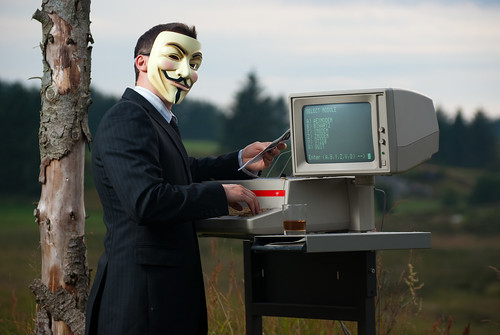
While I really found the conversation around the ethics of internet anonymity interesting when I was a student, that isn't really the direction I'm going when I say there are times I really enjoy being able to post anonymously.
Every once in a while I feel compelled to write or tell someone about something in response to an article or post on a website/blog, but believe it may be inappropriate to name names, as it were. Or I simply don't want to create a trail back to a private situation, for whatever reason.
Also, there have been times I want to better prepare myself to discuss a sensitive social topic, and see suggestions on ways to tackle a situation I want to handle in an informed, gracious, and thoughtful way. Example: "How do I constructively talk about rape culture and gender inequality with a male friend?"
Forums seem to contain a vast amount of opinions where you can find out what people think on every single possible topic under our sun. If people have experienced/thought it, there's a very good chance someone has written about it. All you have to do is examine Google's predictive search suggestions:
Oh people. The things we want to validate.
Despite the crazy, depressing, hearth-breaking, appalling results you can find out there (sometimes it is hard to have faith in humanity after browsing through internet forums), anonymous posting has created a really interesting tool to exchange thoughts and gather information. Particularly on issues that have deep social stigmas and potential impact on the people in your life.
A rambly geek musing on information topics and the like. Not frequently updated, nor focused on anything in particular. Random musing about information behavior, data, news, and whatever pops into my head when I want to procrastinate from other things.
Friday, December 7, 2012
Friday, November 30, 2012
Adding to the Noise
With my recent dearth in blogging, I've found myself wondering what the benefit of blogging might actually be? I mean, there are some people who have really interesting thoughts and perspectives on a whole slew of topics to share with the world that add value (professional sites such as Advice from a Risk Detective or Wonkblog). Or bloggers are documenting some interesting experience or experiment (e.g. studying abroad or cooking on a budget), or simply humorous findings or topical observations (e.g. A Walk in the WoRds). But what if you're like me? Casually gathering up some thoughts, putting them down, and sending them out into the interwebz with no particular goal (though I suppose we want someone to read these random thoughts). Adding another drop in the information ocean.
Is this type of blogging (that I'm doing just now) just adding to the noise?
In school, students were sometimes encouraged to blog on some topic they were passionate about, in order to build some sort of active, dynamic thought-profile. Some fellow MSIM grads managed to pull it off (Free Range Information and The Turning Grille). That professional perspective has always appealed to me, but I've never quite been able to pull off either the discipline nor the implementation. Perhaps it is because for the last decade, I've been writing 'professionally' - academically from high-school through grad school; now my career requires it daily. Regardless, I write blog posts as the fancy strikes me, sometimes regularly, sometimes with months in-between.
And I don't think I'm going to change. I think I'll always be happy to remain primarily a consumer of blog content, rather than a producer.
Friday, July 27, 2012
Learning All The Time
I love my job.
Man I'm a geek. But truly, it is exciting for me to go to work the majority of the time. There isn't a week that goes by that I don't get to do and learn new things.
Concepts I have gathered more knowledge on this week:
1. VLookups in Excel
2. Financial Ratios, Income Statements, and Balance Sheets.
3. Skiing Facilities
4. Supply Chain Management for Utility Pole Manufacturing
5. MS Dynamics AX ERP system
6. Clay Brick and Concrete Block Manufacturing
For me, this diversity of topics is simply perfect. I don't have to become an expert in any one thing, but I'm continually allowed to expand my knowledge base and be challenged in new ways.
Sometimes I struggle with switching back and forth between topics, but I find I can sometimes work more productively if I do. I'll work for a bit on one projects, and then when I find myself struggling a bit to keep my focus, I switch to a second projects. I have done this with varying results - sometimes there is a definite boost to my productivity, but sometimes I just end up getting trapped in feeling like I can concentrate on *anything*.
Then at that point, I just want to surf the web for pictures of baby animals or something.
Thursday, July 12, 2012
Wireless for the People But Not the Government
Recently, I spent two days at a Washington State agency down near the capital. It came as quite a shock to me that in the building (and outside in the parking lot) there was terrible coverage for both mobile reception and 3G connection. It made me wonder why any major mobile telecommunications company would fail to provide excellent coverage to key governmental locations? Or was that intentional? Were the majority of the employees on a network other than Verizon Wireless and had no such issue? Whatever the reason, it left me feeling quite disconnected from the rest of the world, as I additionally had no internet connection to use my laptop.
Arguably, it is a separate issue that there was no public or private WiFi network in the building, either – I suppose it isn’t unreasonable since the agency handles sensitive information, and perhaps it is a security concern. But even so, it makes me wonder. Some employees had Blackberries (which were scheduled to be taken back due to budget cuts), but I never saw anyone from the agency in the slew of meetings I observed bring a laptop or tablet (though smartphones were definitely present).
I am definitely a member of the constantly-connected generation. Personally, being without internet for a few hours makes me twitchy. But it is also impossible for me to get work done without an internet connection, as approximately 95% of my job is tied to having access to the world wide web. While I was on-site, I found myself writing a number of work emails on my phone through the web access email portal we have, wishing all the while for one of those magical little wireless network creating USB sticks. Tried to run my work computer off my phone's network, but was informed that I was not graced with those administration privileges. So I just had to accept my lack of internet and move on, thankful I could still take notes in Word and set reminders for myself for when I was back on the grid.
My handwriting, after all, can be pretty dire when taking speedy notes.
Tuesday, May 1, 2012
Is the Internet Closing Minds?
A recent NPR podcast asked people to debate the question, "Is The Internet Closing Our Minds Politically?". It was fascinating, mostly because there were some very different beliefs about information behavior online. The basis was whether or not "we [are] running the risk of getting trapped in information bubbles, where all we read and see falls in line with our political views?"
And while I find both sides have some interesting points, it it worth examining some of the information behavior and access assumptions underlying the two arguments. I understand that I am part of an elite minority with my education and background, but I don't think it is elitist view to say that I don't believe everyone has equal access to information nor equal knowledge about how to seek out information. Perhaps having a degree in information management makes me biased about information behavior, but the internet for many people has certainly changed the dissemination and acquisition of information. The saying "If its on the Internet, it must be true" is usually said sarcastically, but too often it is a key part of decision making. People find information from a source, and based on prior experience, biases and beliefs (or what is said in social circles), the source is given more or less validity. People decide "oh, I know this source is trustworthy" or "oh, this source is a joke". And the more they trust the source, the easier it becomes to assume the source has verified its information (which in an ideal world would be what all news agencies do).
One key thing that I value about being a researcher in a business environment is that it is really, really important that I understand my information sources. While doing economic or industry research, most of the time there are conflicting sources for data I need, whether its employment numbers in a state or the number of operations in a certain industry. If I find a secondary source that analyses primary data, I need to know what data they were including and how they crunched those numbers. I have seen it bleed into other areas of my life, making me all the more curious about where people get their information and what assumptions are based upon.
When sites on the internet such as Facebook, Google, and Twitter engage is social filtering behavior (tailoring search results to each user), that can change what information we are exposed to when we search online. The argument was made that this can be beneficial - crowdsourcing results through your social circle might expose you to new ideas. But is that really the case? Do many people actually surround their digital selves with people who have opposing viewpoints? Isn't one of the more powerful parts of online interactions is that people with similar outlooks and beliefs can more easily congregate, regardless of where they are in the physical world? I'm not sure people need help seeking out others who view the world like they do.
People need help finding information that expands their knowledge, not constrains or limits it. And that is a lot harder to do than filter out and customize results.
Labels:
behavior,
data,
decision making,
Google,
media,
musing,
question,
social media,
technology
Wednesday, April 25, 2012
Made it Through
So I've now been gainfully employed for almost eight months. A bit hard to believe how quickly things have flown. It feels like from September until December, things were crazy for me because I was trying to learn and absorb so many new things (the 'drinking from a firehydrant' phase). At the beginning of January, the workload increased with the beginning of a major 'busy season' for the firm, which makes sense at an tax/assurance firm. There were some crazy weeks where I really felt overwhelmed, but at the same time quite proud that I was able to manage through it.
Now things have calmed a bit with the passing of April 15th (well, 17th this year). I still frequently have questions, but I'm slowing growing more and more confident in my own abilities to do my tasks well and in a timely manner. It feels as if I've managed to tame the information madness that comes from starting a new job, and have emerged stronger and more adept for the experience.
And sorting through one area of life often makes it easier to tackle others. I've been on a bit of a health bent, working towards a more healthy body and fitness level. Nutritional information and research exists in such an incredible environment. It is one area that you can't avoid in your life - everyone has to eat. And the question of what to eat - and all the tangents that question produces - is answered with a vast cacophany of different sets of data and opinions. I definitely am planning to explore this area further, not just for my own education but because the information behavior around food is incredible.
Monday, October 24, 2011
Comments
Someone recently shared a link to a blog, pointing out the comments section introduction:
"Please use the comments to demonstrate your own ignorance, unfamiliarity with empirical data, ability to repeat discredited memes, and lack of respect for scientific knowledge. Also, be sure to create straw men and argue against things I have neither said nor even implied. Any irrelevancies you can mention will also be appreciated. Lastly, kindly forgo all civility in your discourse . . . you are, after all, anonymous."
I thought this was brilliant. I am not someone who comments often on articles or blogs, but I sometimes glance through the comments when I finish reading. I primarily browse through the online versions of BBC News and the Seattle Times, for world and local news, respectively. The Seattle Times commentators certainly fit the above statement a little too closely for my liking. It frequently seems to be a free-for-all to see who can come up with the most idiotic or unsubstantiated content, belittling others and generally presenting themselves poorly. People seem to sometimes react to the feeling anonymity in the digital realm by behaving in very different manners than they would in-person.
In my information ethics course, we discussed the pros and cons of anonymity from both an ethical and policy perspective. It isn't a clear-cut, black and white issue, but it is an important area to consider as new technologies and information behavior continue to emerge and evolve. There are cases where anonymity can facilitate more honest feedback, particularly when there are power disparities that hinder people from feeling completely able to voice opinions otherwise. Employee engagement/feedback surveys are a good example of this.
But for something like social media or other by-choice dialogue, I wonder if anonymity is the best choice. I understand the comments on cute kitten pictures at icanhazcheeseburger.com don't often take a serious tone, and I wouldn't argue that a site like that requires full name disclosure. But on a newspaper site like the Seattle Times? I think that it is a little too convenient for people to say outrageous things on an issue, throw out all sorts of data that they do not back up, and do it all rudely.
In terms of social media, I was really disappointed with the newest development by Google on their most recent foray into social media, Google+. Google initially instated a policy that required users to use their real names when signing up for Google+. I seemed to have missed most of the commentary and "controversy" over that, but Mashable recently reported that Google would be relaxing that policy to support pseudonyms and nicknames. Seems like that move will dilute the community-concept (including knowing who your neighbors/'friends' are) that Google was going for. Ah well. Maybe I'll go post an anonymous comment about my concerns.
"Please use the comments to demonstrate your own ignorance, unfamiliarity with empirical data, ability to repeat discredited memes, and lack of respect for scientific knowledge. Also, be sure to create straw men and argue against things I have neither said nor even implied. Any irrelevancies you can mention will also be appreciated. Lastly, kindly forgo all civility in your discourse . . . you are, after all, anonymous."
I thought this was brilliant. I am not someone who comments often on articles or blogs, but I sometimes glance through the comments when I finish reading. I primarily browse through the online versions of BBC News and the Seattle Times, for world and local news, respectively. The Seattle Times commentators certainly fit the above statement a little too closely for my liking. It frequently seems to be a free-for-all to see who can come up with the most idiotic or unsubstantiated content, belittling others and generally presenting themselves poorly. People seem to sometimes react to the feeling anonymity in the digital realm by behaving in very different manners than they would in-person.
| Photo by Stian Eikeland |
In my information ethics course, we discussed the pros and cons of anonymity from both an ethical and policy perspective. It isn't a clear-cut, black and white issue, but it is an important area to consider as new technologies and information behavior continue to emerge and evolve. There are cases where anonymity can facilitate more honest feedback, particularly when there are power disparities that hinder people from feeling completely able to voice opinions otherwise. Employee engagement/feedback surveys are a good example of this.
But for something like social media or other by-choice dialogue, I wonder if anonymity is the best choice. I understand the comments on cute kitten pictures at icanhazcheeseburger.com don't often take a serious tone, and I wouldn't argue that a site like that requires full name disclosure. But on a newspaper site like the Seattle Times? I think that it is a little too convenient for people to say outrageous things on an issue, throw out all sorts of data that they do not back up, and do it all rudely.
In terms of social media, I was really disappointed with the newest development by Google on their most recent foray into social media, Google+. Google initially instated a policy that required users to use their real names when signing up for Google+. I seemed to have missed most of the commentary and "controversy" over that, but Mashable recently reported that Google would be relaxing that policy to support pseudonyms and nicknames. Seems like that move will dilute the community-concept (including knowing who your neighbors/'friends' are) that Google was going for. Ah well. Maybe I'll go post an anonymous comment about my concerns.
Labels:
behavior,
challenging convention,
decision making,
musing,
question,
social media
Monday, October 10, 2011
A 15 page report? That'll be $1,295 please.
One aspect of my role as a researcher for an accounting firm is to provide industry and economic outlook write-ups as part of larger client projects. As a department, we subscribe to a number of different services that allow us access to reports and analysis, but I also look for other relevant sources for each topic. I often find reports that look like they may be relevant, but require a subscription that the department does not hold.
For the most part, the subscription-based model is understandable if annoying to someone like me. I wouldn't want to access the source if it weren't valuable, and if it is a business producing the data and/or analysis, it makes sense that they charge for it.
But the amount sometimes seems somewhat disproportionate. I recently found a Gartner market report that seemed likely to contain pertinent information. I knew we don't subscribe to them, but I was hoping to find a report that might be summarized or quoted elsewhere. I glanced down at the purchasing information out of curiosity... $1,295.00 for a 15 page report.
Hmmm. So that doesn't fit the budget.
Honestly though, the value-add of the information I could fish from that doesn't seem to match the price tag. It makes me wonder who would consider the data and analysis in those 15 pages actually worth it to pay out that much money. And it also makes me really curious about what kind of content is in the report! That has to be some excellent and astounding research, right?
At least I hope it is...
PS: If only I had figured out a way to charge $86 dollars a page during my undergraduate and graduate school experience... they I might have made a profit rather than being in six-digit debt.
Thursday, September 29, 2011
Read, Analyze, and Write... QUICKLY
The most amazing thing about being a professional researcher outside an academic context? [Okay, other than the paycheck] The fact that there is a direct link between the work I'm doing and some sort of business action that takes place. I went into a MS graduate program largely because I was frustrated by the idea of continuing down the pure-academia route. It is critical to study and analyze the world, but all the research that I did as an undergrad... where was the value to anyone other than me as I developed analysis and writing skills? Of course not everything done needs to have an identifiable value attached to it, but from a career point of view? Well I have finally found a route that puts all the skills I've worked on building the last six years through "higher education", and that is working as a researcher at an accounting and consulting firm in Seattle. It is the most amazing opportunity I never would have known I was missing out on if I hadn't been hired.
The best parts so far have been the incredible office environment (unlimited Starbucks brewed coffee... I mean, really?) and people that have welcomed me to the firm. The work is challenging and extremely different. I mean really, anyone who knows me never would have guessed I would end up working in an even remotely finance-related environment. Without going into specifics, it isn't your typical research-type job. We're meant to be a resource for the firm, yes, but we're doing it with an output/results focus that includes billable hours and profit.
My most enjoyable projects thus far have been the industry-related writing pieces I've done, which means I've gotten to research up on the motorcycle industry, paint & sealant manufacturing, semiconductor manufacturing, and property management so far. The diversity of topics and the variety of frameworks means that I've found my ideal career context. I'm working in an environment that keeps my brain engaged, the type of work changes frequently, and I am in a constant learning mode.
Basically I've found a way to be a paid perpetual student. Man I love it.
PS: Writing on my lunch break, I have to admit, I love the view when I turn around in my desk chair. It's a good thing I don't face the window, because I'm not sure I would be able to concentrate.
Wednesday, September 21, 2011
Real-World, Here I Come
Well I am officially not a graduate-school geek. That whole graduation thing happened a few months ago, and I’ve been acclimating to non-student life ever since. I had one last hurrah of a summer, thankfully, before turning into a “real-world” citizen who (thankfully) managed to find a job.
Summer went something like this: sleeping; some contract work; watching Sounders FC matches; sleeping; job hunting; sleeping; panic-attacks over lack of job; sleeping; buying a car; sleeping; family members from NY arriving (2 adults, 4 children under 7); international friend visitation; babysitting mentioned nephews & niece; job interviews; driving 1,000 miles in one week; Whistler-with-friends; job acceptance & paperwork; goodbyes to friend and family; driving more between Seattle & Ferndale; starting new job…
Notice how sleep stopped happening along the way? Yeah, I did too.
So now the new job is fabulous, even though it has felt akin to trying to drink out of a gushing fire-hydrant. I’m still working on figuring out the new life-work balance. The weekdays are still difficult to adjust to – full days in the office and trying to squeeze in some evening activities before a relatively early bedtime. It is stress-relieving to finally have a full-time paycheck, but the stress from trying to figure out repayment of student loans is epic.
By the way, I should make a note that if the federal government wants to stimulate the economy, they should do a student-loan forgiveness program en masse. There would be a HUGE influx of revenue into the market from all of us recent graduates who are currently putting at least half of our paychecks into paying off debt. I’d still have some privately-held debt, but it would cut my total amount in half.
And the whole system for repayment is terribly confusing, disjointed and poorly designed.
But regardless, the only direction to move is forward.
Wednesday, July 6, 2011
Graduation -- A Master's Degree Completion
A minor miracle has happened. I have survived graduate school.
What a complex and challenging two years it has been, learning concepts and frameworks that I never would have dreamed existed. The MSIM degree at the University of Washington's Information School has been a growing and learning experience. I've been exposed to people and ideas that have allowed me to see problems and the world from new perspectives and within many different contexts.
When I graduated from my undergraduate program at The American University, there was a certain way that I viewed the world, and my time there shaped my skills and abilities, including giving me a strong foundation in research. Shifting to the field of "information" has actually been a natural progression for me.
I've discovered I am an information gatherer.
Whether trying to build a case for a peace program in Kashmir or developing a content strategy for a company, having the right information is critical. I find it incredibly satisfying to solve problems using rigorous and robust information.
And I am looking forward to the next step of finding a career that isn't just a job, but will allow for finding engaging and dynamic solutions for how to connect people with the information they need.
Labels:
academics,
decision making,
education,
event,
information,
musing,
question,
Seattle,
UW
Friday, April 29, 2011
Partners in Emergency Preparedness Conference 2011
Attending the Partners in Emergency Preparedness Conference was a new experience for me. I have attended a number of conferences in the last few years as a student, but this was the first conference where I felt I might actually be attending as a future practitioner. The opening keynote addresses both approached some of the high-level issues associated with emergency and disaster management. The booths of vendors were quite interesting to peruse - the products and services available ranged from communication systems to emergency rations. The first session I attended was on building resilience community partnerships - how to form connections between businesses, government, and citizens.
And this opportunity was also very special because I was given the opportunity to take part in Annie Searle's presentation "Tweet Me Up: Social Media Tool and Crisis Management". Annie presented some of the emerging trends and risks associated with the increasing prevalence of social media use in both normal and crisis business environments. Speaking to about 150 people, the session covered a number of benefits as well as the challenges of social media that appear in the crisis management framework.
After recommending organizations (including government, business, and NGOs) find ways to better adapt to the new reality of social media, Annie passed the microphone to me. A bit nervous to be lecturing to a room full of experienced professionals, I tried to clearly present some of the social media tools available, and how they can work and be managed. It is always an educational experience to try and present a topic one is very familiar with to an audience you must assume knows little to nothing about.
Social media isn't going away. One of the questions from the audience was, in short, about what if Facebook (or the like) isn't around in 5 years? Should people (organizations) jump on board and go through all the headaches that are being seen with trying to integrate social media into more and more business environments? And my first thought was it doesn't matter if Facebook isn't around in 5 years. It is simply one "tool". The methods and mentalities are changing in society, just like what happened with email. And someone else in the audience pointed out just that - the conversations businesses and organizations are having today about social media are very similar to those that were taking place 15 years ago over email. An interesting thought to mull over.
Wednesday, April 13, 2011
At A Loss for Words
Seriously. Not from anything horrific or sad or wonderful. I just seem to find myself slogging through my brain, trying to find words these days. This is how I know I am at an almost critical burnout point. Meaningful thoughts are important to communicate well, and I'm not at the top of that game these days. So I'm saving my words for what I must get done in the next 57 days until graduation.
I had a whole food and information ramble kind of tossing about in my mind, but at this point I'm afraid of how long it might take me to put those sentences together. I'll have to give it a go, regardless.
Friday, March 25, 2011
Women, Cyberspace, and Information
| CC License Use (http://flic.kr/p/4TAdv6) |
So I had an interesting article sent to me the other day by a friend. One of the Financial Times (UK) blogs posted on "Inequality in Cyberspace", about the numbers showing that there seems to b. The author, Liz Bolshaw, mentions Noam Cohen's NYT piece left off talking about how only 13% of Wikipedia contributors are women, and Joseph Reagle's justification that women are “less willing to assert their opinions in public”.
HAHA. That's an interesting thought. Haven't gotten that impression from most of the women I've met.
My first though about the whole gender gap isn't concern, it's "women have better things to do than edit Wikipedia". Not sure how true that is, but it seems to me that the people who are the most qualified to do something don't have the time to do what they need to do. Not that women are more qualified by any means, but they're certainly not less qualified. I'm not convinced that women are less well-represented as an internet population, but really? Is it something we should be concerned about - that women are not contributors to Wikipedia? My association with Wikipedia-editors is drunk frat boys mucking around with various entries. Is that something women should be aspiring to? The power of outsourcing knowledge creation to the cyber community (Wikipedia is only one such example) is certainly a force to be considered, and the power of it comes from the diversity of the people who are contributing. I would be more concerned with those who are excluded from contributing (directly or indirectly), not those who chose not to participate.
An interesting side note - women are actually really well represented in my program. Less so in the undergrad version, but there is still a good number, or at least it seems that way to me. It has been quite an experience the past two years as I've studied in a hybrid field that mixes strong gender stereotypes. The program is based out of the field of Library Science, but it has been heavily influenced by Information Technology and Business. I have the feeling that there are less gender stereotypes because of this hybridization, but I have yet to really immerse myself into the working field. All I know, there are some kick-ass women out there who are managing information and sharing what they know with the world (see some Seattle folks like Karine Nahon, Vanessa Fox, Samantha Starmer, and Alix Han). Maybe we aren't writing in Wikipedia, but women are certainly invested in cyberspace and information.
Labels:
challenging convention,
change,
future,
musings,
Seattle
Wednesday, March 2, 2011
The Knowledge Economy - Don't Kill the Education Budget
An article on the BBC News website yesterday was titled "Graduates - the new measure of power". The main take was from an education perspective, looking at the shift from raw resources as sources of power within nations to knowledge and intellectual resources. This is not a new topic - scholars have been exploring the shift to the "knowledge economy", but perhaps I've been abnormally exposed to the school of thought since I'm getting a degree in information. Nevertheless, it is a recognized fact that measuring the "power" of a nation must calculate the innovation, information, and knowledge that is being generated within its borders and its citizens. This article emphasized the role that formal educational institutions play in this generation of value, and how all across the globe governments are heavily investing in their future through students and schools.
Maybe the numerous states in the US, such as Washington, should consider this fact before they continue to viciously slash at the state-supported education budget for schools such as the University of Washington. As the Governor's new budget presents a worst-case scenario of an additional 40% slash, it is important to understand what has come already (from a letter to the State legislative from Interim President Phyllis Wise).
The steepest decline in state funding for the UW came in 2009-2011, when the state and the nation entered the Great Recession. Over a two-year period, the University of Washington lost over $132 million in state funding, roughly 30% of its state appropriation. Even with two 14% tuition increases, over $57 million in cuts were still necessary to balance our core education budget.
Major cuts included:
• Eliminated 950 jobs
• Froze enrollment for resident undergraduates
• Closed/eliminated 12 degree programs; 14 MA programs now self-sustaining
• Increased advisor load by 180 students per advisor
• Closed 384 undergraduate lecture sections and 130 small group sections
• Decreased number of lab sections by 20%, while average lab size increased 38%
• Closed 4 writing/tutoring centers and 2 computer labs (loss of 1/3 student workstations)
• Closed 1 library, reduced library hours, and canceled subscriptions to over 1,200 journals
• Reduced hundreds of hours of student counseling services (advising, financial aid, health)
As I'm preparing to graduate in June from a program that is not state-supported at all, I'm still concerned as a citizen of Washington about the future of education systems if these huge cuts are continued. Economies recover, but it is likely going to take years and years for educational institutions to recover from the hemorrhaging of funds out of their budgets. It seems awfully short-sighted for any government to pull money from the one resource that is almost guaranteed to reward the economy handsomely in the future.
Labels:
academics,
behavior,
challenging convention,
decision making,
education,
future,
government,
innovation,
musings,
news,
Seattle
Monday, February 7, 2011
Creativity, Law, and Change
I recently listned to a well-articulated TEDTalk by Larry Lessig on "Laws that Choke Creativity". A really interesting and thought-provoking piece about how the changes in culture are leading to creative conflicts in the newest generations.
"We made mixed tapes; they remix music. We watched TV; they make TV. It is technology that has made them different, and as we see what this technology can do we need to recognize you can't kill the instinct the technology produces; we can only criminalize it. We can't stop our kids from using it; we can only drive it underground. We can't make our kids passive again; we can only make them, quote, "pirates." And is that good? We live in this weird time, it's kind of age of prohibitions, where in many areas of our life, we live life constantly against the law. Ordinary people live life against the law, and that's what I -- we -- are doing to our kids. They live life knowing they live it against the law. That realization is extraordinarily corrosive, extraordinarily corrupting. And in a democracy we ought to be able to do better."
I thought this was one of the best summaries of one of the biggest social difficulties of the times - the shifting notions of right and wrong, and what kind of impact that has on us as a culture. I think I have some more thoughts on this, but for now I have to get back to writing a paper on the concept and ethics of a national "smartcard" ID. A fascinating topic that has led me down many tangents (such as this video) though most of the diverging hasn't been useful for the paper. Oh well. At least the tangents are interesting and educational.
Labels:
academics,
behavior,
challenging convention,
change,
decision making,
future,
innovation,
musings,
speaker,
TED,
video
Tuesday, February 1, 2011
Anonymity, Privacy and The Debate on National Online IDs
I think the National Internet ID conversation that has been recently taking place is quite an important and interesting piece to be discussed. I've been approaching a research piece on it from a risk-perspective, but part of that is a risk to privacy and anonymity. In an article by Helen Nissenbaum on anonymity, I thought she had a good point - that anonymity is really about being "out of reach" from consequences. Anonymity can be abused and used as a negative thing (think criminal activities) but many times it is critical for certain systems to work (as mentioned, voting and peer-review).
In the draft of the "National Strategy for Trusted Identities in Cyberspace" released in June 2010, their vision of the future sounds pretty good. "Individuals and organizations utilize secure, efficient, easy to use and interoperable identity solutions to access online services in a manner that promotes confidence, privacy, choice, and innovation." (pg. 12) Some interpret the strategy to mean that Americans could begin to have unique online identities used to access password-protected websites. That's an interesting and slightly worrying thought. While "confidence, privacy, choice and innovation" sound good, what does that mean in a practical sense?
Would having some sort of online identification be a threat to anonymity and a violation of privacy? Already there is so little privacy on the internet - maybe if the government regulates more, there would be less abuse of breaches in privacy and security. But I am a bit leery of the idea of allowing a government to so in-depth access or observation to the behavior of citizens. Nothing sounds so tyrannical as being observed at every moment or having to curtail one's speech for fear of reprival. And I'm not sure that an Online ID would be the most conducive tool for an open and free democratic society. But on the other hand, I like parts of the idea in theory - but things look so good on paper sometimes when in reality they just are a really bad idea.
Labels:
academics,
behavior,
challenging convention,
change,
data,
decision making,
future,
government,
innovation,
management,
musings,
news
Monday, January 31, 2011
Airplanes, Seattle, and Visualizing It All
This quarter I started a really fascinating independent study project with a Foster School of Business professor, Dr. Richard Nolan. I get to do some research for him on people, places, and time - all related to the aeronautic-powerhouse Boeing and its role in the Seattle/Puget Sound Area.
Specifics aside, I've really enjoyed learning about three specific things.
1) The idea of the "industry commons"
This is an idea that seems to in part come from the medieval practice of sharing a common space for the good of a community. Sharing resources and ideas in a collective space is a way for an industry to innovate and strengthen itself. There is the idea that the movement of tacit knowledge happens more readily in geographically bound spaces through more informal transfers - in short, similar people are drawn together in one place and share their knowledge with each other in non-professional settings such as in a bicycling lunch group. When an industry has certain geographic concentrations, there is a tendency to see others of the industry (individuals and companies) drawn to that location.
2) Visualization of non-linear information
This has been my biggest challenge. I have done a lot of research over the past 8 years or so, and yet this is the first time I have to "visualize" my findings. I can create lists and draw conclusions no problem - but finding a way to visually represent the data is quite a daunting task. I've taking classes with design elements, but this is actually having to create meaningful visuals. Today I discovered MindNode which will hopefully help me out as I map out pretty complex relationships between people, places, organizations, and time. Hopefully they'll turn into something interesting and clear at the end, because right now they're kind of confusing. The first draft is always the hardest, they say, and then the following iterations should hopefully become easier to improve.
3) Airplane and Seattle knowledge
This has been a side bonus of the project - I've been reading lots and lots for this, and I find myself discovering very interesting little facts and tidbits about Seattle and its history. I love it - I've been out here almost every year of my life before finally moving here in 2009, and this city continues to enchant me. Learning about the richness of its people and places has been wonderful.
The other thing is that I get to learn about airplanes - I retain less of the information but it's still a cool subject. I've always loved traveling, and now it is quite cool to know more about the giant beasts that get me from one place to another through seemingly impossible conditions.
PS: Don't research airplanes if you're nervous about them already.
Labels:
academics,
Boeing,
data,
design,
information,
musings,
Seattle,
visualization
Monday, January 24, 2011
Emerging Technologies - Connecting or Isolating?
There are some interesting conversations happen around the world about the role of social media and how human behavior is changing alongside the emergence of the newest ways of communication.
Recently on the Colbert Report, Sherry Turkle talked about her recent book "Alone Together". The thesis of her book is summed up by a recent by Paul Harris in an article in The Guardian: "technology is threatening to dominate our lives and make us less human. Under the illusion of allowing us to communicate better, it is actually isolating us from real human interactions in a cyber-reality that is a poor imitation of the real world."
I think this is a fascinating hypothesis, worth conversation and further exploration. I seem to, by default, love the ease of communication and accessibility I have to friends around the world. When you have friends from Canada to England, Germany to Cambodia, and France to Honduras, it seems somewhat miraculous to be able to email, call (with video), text, and instant message all of them for either free or very reasonable prices. Fifty years ago - heck, twenty five years ago - this kind of communication would have racked up a bill a mile long. But I take it for granted that I can instantly write an email to the child I sponsor in Honduras, then have a free video Skype call with my friend in Cambodia, and follow it up with sending a text for just a few cents to another friend in England.
Yet this access does make it difficult to keep up with everyone. I rarely sign into Skype these days, often because I find it more distracting that I can afford with work and school, or simply because I forget to. Emails that are easy to send sometimes take weeks for me to get around to finishing, and loiter in my drafts box for a while. There are so many ways to communicate these days, but I still have many days where I feel the lack of communication in my life. I still write hand-written letters every once in a while, simply because there is something incredibly special about sending and receiving "snail-mail".
But I'm not sure that we're being isolated because of this technology. I think it is a possible repercussion for some people, but I'm not sure it is a societal epidemic. The key point, though, that I take away from this book and the idea of "cyber-skepticism" is that it is good to be skeptical. Just because social patterns are forming does not mean those are necessarily positive steps forward. There is the cited story about the woman who left a Facebook suicide note, and her 1,048 "friends" on Facebook failed to take action to do something, or take it seriously. I think this is a tragic story where there was a disconnect between cyber-life and "real"-life, and should serve as a catalyst for self-examination as an internet society. At the end of the day, I think it isn't the technology we have to worry about - social media is only the tool, neutral without the people and actions behind it.
Labels:
behavior,
information,
musings,
news,
question,
social media,
technology
Wednesday, January 19, 2011
Ity-Bity Little Tortoises
Because they're so cute, I had to share a quick link to the Woodland Park Zoo's tiny little new members. It's little moments like this that remind me why we have to strive to let people know the importance of protecting creatures like these from extinction.
Plus, watching those tiny little buggers crawl around made me smile.
From the blog:
Egyptian tortoise hatchlings, 2 weeks old, behind the scenes at Seattle's Woodland Park Zoo in the Day Exhibit. The Egyptian tortoise is critically endangered with populations facing severe pressure from habitat degradation and the illegal international pet trade. Learn more about this species and how Woodland Park Zoo is helping to protect it in the wild on the zoo blog: http://bit.ly/gPzl2Q
Subscribe to:
Posts (Atom)